
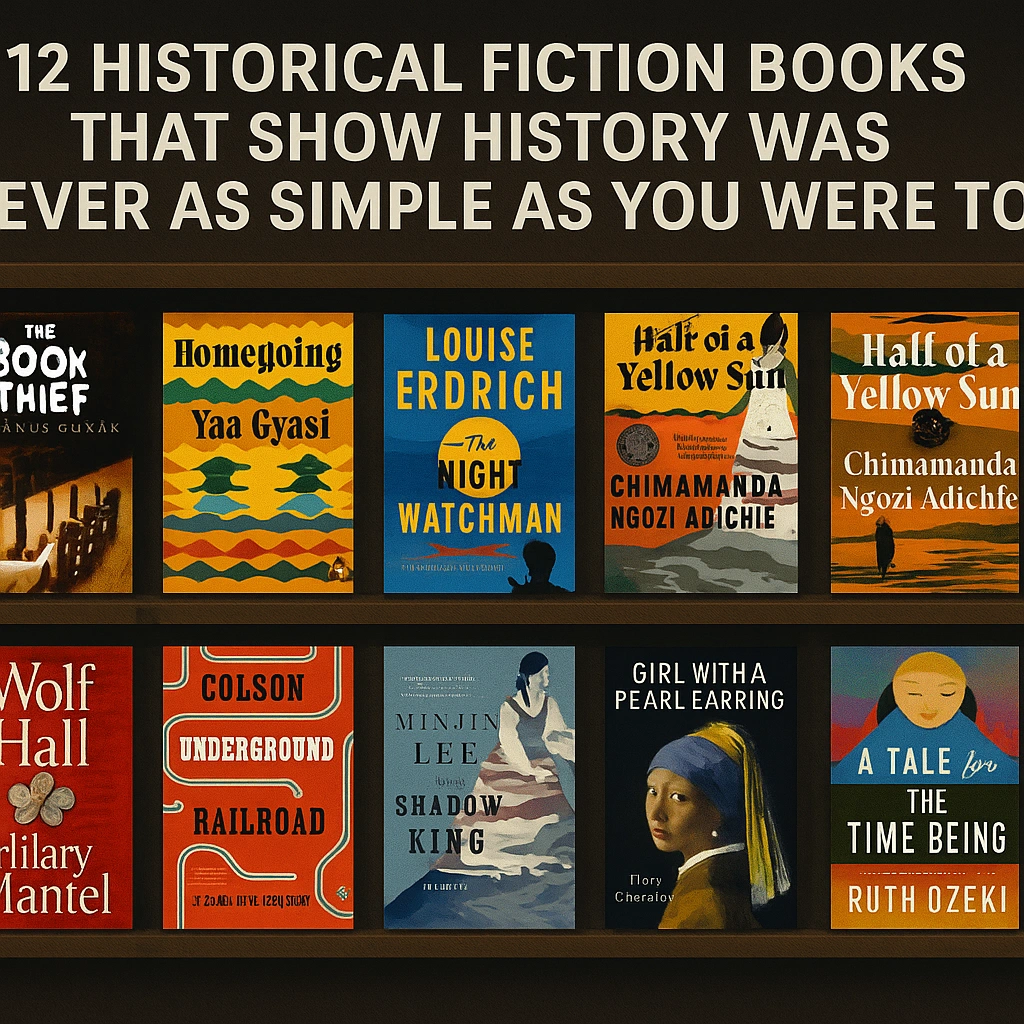
History, as taught in classrooms, often appears neatly categorized—dates, empires, battles, treaties, and revolutions. But real history is messy, complex, emotional, and deeply human. It is written by victors, filtered through politics, and stripped of nuance. Enter the genre of historical fiction—where writers breathe life into the forgotten, give voice to the silenced, and blend documented fact with imagined interior lives.
Table of Contents
ToggleThe best historical fiction doesn’t just transport readers—it challenges perceptions and invites empathy, revealing the gray zones between morality and survival, justice and injustice, freedom and fear.
Here’s a curated list of 12 powerful historical fiction books that remind us: History was never as simple as you were told.
1. The Book Thief by Markus Zusak
Setting: Nazi Germany, 1939
Theme: War, mortality, resistance, storytelling
Told from the perspective of Death, this novel explores the life of young Liesel Meminger, who steals books to survive in a world unraveling. As her foster family hides a Jewish man in their basement, the narrative reflects the moral complexity of ordinary Germans during the Holocaust. It disrupts the black-and-white narrative of evil and innocence, showing the nuances in those caught in war’s grip.
“Even death has a heart.”
2. Homegoing by Yaa Gyasi
Setting: Ghana and the United States, spanning 18th to 20th century
Theme: Slavery, legacy, African diaspora
Through two half-sisters—one sold into slavery and the other married to a British colonizer—Gyasi traces seven generations of a family tree. It lays bare how colonialism and systemic racism ripple across continents and centuries. A stark rebuttal to sanitized versions of African and American history.
3. The Night Watchman by Louise Erdrich
Setting: 1950s North Dakota, USA
Theme: Indigenous rights, resistance, community
Based on the author’s grandfather, this novel details the fight against Native dispossession. Through Thomas Wazhashk, a Chippewa night watchman, Erdrich reveals how governmental policies attempted to erase Native identity—not in the 1800s, but in the mid-20th century. An essential narrative that underscores the ongoing nature of Indigenous resistance.
4. Half of a Yellow Sun by Chimamanda Ngozi Adichie
Setting: Nigeria, 1960s (Biafran War)
Theme: Nationalism, colonial legacies, civil conflict
Adichie’s novel tells the story of the Biafran War through the lives of five characters. The war, largely forgotten globally, is shown here in gritty, emotional detail. It challenges the simple narrative of colonial independence, revealing the deep fractures and external manipulations that follow.
5. Wolf Hall by Hilary Mantel
Setting: 16th-century England
Theme: Power, religion, perception
Through Thomas Cromwell’s eyes, Mantel reframes the story of Henry VIII, Anne Boleyn, and the Reformation. Cromwell, often painted as a villain, becomes a complex, brilliant survivor in a world where loyalty and danger coexist. Mantel’s trilogy rewrites Tudor history with an intimate, psychological depth.
6. The Underground Railroad by Colson Whitehead
Setting: Antebellum Southern USA
Theme: Slavery, escape, freedom
What if the Underground Railroad was an actual railroad? Whitehead uses magical realism to recast the historical escape routes, highlighting how slavery mutated from state to state, often in insidious ways. It’s a raw, emotional, and experimental exploration of freedom.
7. Pachinko by Min Jin Lee
Setting: Korea and Japan, 1910s–1980s
Theme: Immigration, identity, generational trauma
This multigenerational saga follows a Korean family exiled in Japan. It dismantles oversimplified ideas of WWII-era Asia and reveals how colonialism, racism, and classism shaped generations of Koreans in Japan—often discriminated against, despite being born there.
“History has failed us, but no matter.”
8. The Shadow King by Maaza Mengiste
Setting: Ethiopia, 1935
Theme: Anti-colonialism, memory, women warriors
Set during Mussolini’s invasion of Ethiopia, this novel reimagines history by centering women in warfare—often overlooked in textbooks. With lyrical prose and haunting imagery, it spotlights how resistance is gendered, emotional, and cultural.
9. The Paris Library by Janet Skeslien Charles
Setting: Paris, WWII
Theme: Resistance, literature, occupation
Based on the true story of the American Library in Paris, this novel honors the librarians who defied Nazi censors and continued lending books to Jewish readers. A quiet but powerful act of rebellion that history rarely credits—reminding us that resistance comes in many forms.
10. Beloved by Toni Morrison
Setting: Post-Civil War Ohio, USA
Theme: Slavery, memory, haunting
Inspired by the true story of Margaret Garner, a formerly enslaved woman, Morrison’s novel confronts the unrelenting trauma of slavery. The ghost of a murdered child becomes a metaphor for how the past lingers in the bodies and psyches of the living. It demands readers unlearn romanticized versions of emancipation.
“Freeing yourself was one thing; claiming ownership of that freed self was another.”
11. Girl with a Pearl Earring by Tracy Chevalier
Setting: 17th-century Delft, Netherlands
Theme: Art, class, female agency
A fictionalized account of the life behind Vermeer’s iconic painting, this novel reflects how art history often erases the lives of women and workers. By imagining the story of the maid-turned-muse, Chevalier explores gendered silence and power dynamics in a patriarchal artistic world.
12. A Tale for the Time Being by Ruth Ozeki
Setting: Japan, Canada, multiple timelines
Theme: Suicide, Zen, history-as-narrative
Though partly contemporary, Ozeki’s novel bridges personal trauma with historical memory—from kamikaze pilots to tsunami survivors. It deconstructs linear history, asking: What is real? What is recorded? What is remembered? Ozeki’s metafictional approach challenges the idea of objective truth.
🔍 Why Historical Fiction Matters
These 12 books remind us that history isn’t merely about kings, wars, and treaties, but about:
-
The everyday lives of forgotten people
-
The cultural contexts behind events
-
The emotional truths behind the facts
-
The unreliable nature of memory and recorded history
Each author wields fiction as a tool—not to distort facts, but to humanize them. Through imagined dialogue, composite characters, and internal monologues, they offer what history books can’t: emotion, empathy, and existential nuance.
Read More: golden state warriors vs houston rockets match player stats
📚 How to Read Historical Fiction Critically
To truly appreciate historical fiction:
-
Read author’s notes—most writers explain their research and creative liberties.
-
Cross-reference with history—it’s fascinating to discover where fact meets invention.
-
Question the narrative—who is telling the story, and what’s missing?
-
Explore multiple perspectives—especially those from marginalized or colonized voices.
🙋 FAQs
Q1. Can historical fiction be historically inaccurate?
Yes, and often is—to fill in emotional or narrative gaps. However, good historical fiction is rooted in real research and intent.
Q2. Are all these books based on real events?
Most are inspired by real periods and sometimes real people. The emotional arcs may be fictional, but they reflect deeper truths.
Q3. Why not just read history books instead?
You should! But historical fiction complements history—it lets you feel it, not just know it.
🎯 Final Thoughts
In a time when history is increasingly contested and rewritten, historical fiction offers a bridge between memory and imagination. These 12 books are more than compelling reads—they are invitations to reexamine what you think you know.
They remind us: The past was never simple—and the stories we tell about it never neutral.
Would you like a custom image showing all 12 book covers in a bookshelf-style collage? I can create on.
Read More:
pacers vs milwaukee bucks match player stats
golden state warriors vs houston rockets match player stats
pacers vs milwaukee bucks match player stats